
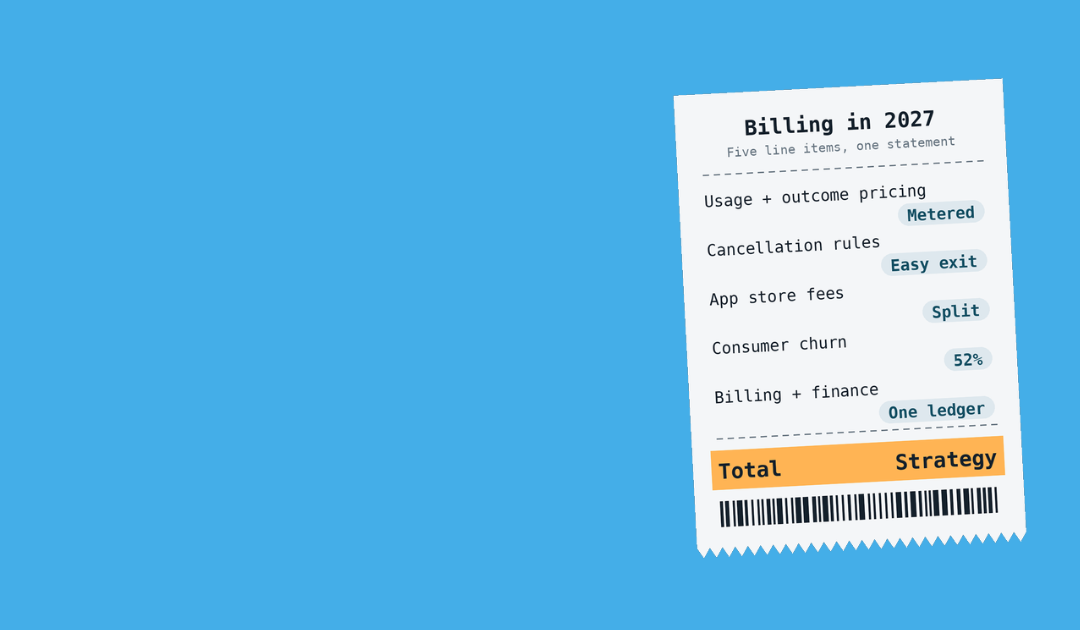
For years, billing was the plumbing of a subscription business. Nobody talked about it until something broke. That has changed. Pricing experiments, platform fee changes and tightening consumer rules are landing at the same time, and billing has become a strategy question that finance, product and legal all need a say in.
Here are the five shifts worth putting on your radar as the year closes.
1. Usage and Outcome-Based Pricing is Mainstream
Stripe announced the Metronome deal in December 2025, with its CEO framing metered pricing as the native business model for the AI era. Analysis from Sacra puts the reported price at around $1 billion, and a vendor comparison from Stigg notes the acquisition completed in January 2026.
Stripe's own description of its billing customers shows how varied the models have become. In its post on the integration, it cites credit burndown at Lovable, outcome-based billing at Intercom, and straightforward subscriptions at Anthropic, all running on the same platform.
In June, Zuora launched an AI Monetization Suite that includes a pricing simulator, letting companies model the impact on billing, revenue and margins before they launch. A 2026 decision guide from Solvimon reports that Chargebee now ships usage-based billing, prepaid credits, outcome pricing and agent billing. (Note that this guide comes from a competing vendor, so read it as one perspective.)
Outcome-based pricing is the most striking variation. Zuora's write-up on Zendesk describes a model where customers pay only for issues the AI resolves autonomously and says its research across more than 70 companies found most settle on some form of usage pricing when they add AI.
The question is no longer "subscription or usage?" It is how to blend seats, credits and outcomes without confusing customers or breaking revenue recognition. Hybrid pricing is becoming the default, and your billing system must support it.
2. Cancellation Rules: a US Patchwork and a UK Countdown
The US picture is messier than the headlines suggest. The FTC's amended rule, nicknamed "click-to-cancel," was finalized in October 2024, but the Eighth Circuit vacated it in July 2025, largely on procedural grounds rather than on the substance. That left the 1973 rule in place, which does not reach most modern negative option marketing, including autorenewals and free-trial conversions.
In March 2026, the FTC started over. Its advance notice of proposed rulemaking set an April 13 deadline for public comment. Per Robinson & Cole, the process could continue through a proposed rule, another comment round and potentially a final rule.
None of this leaves businesses in the clear. Cooley notes that ROSCA remains fully in force for online negative option offers and the FTC can still bring actions under Section 5 of the FTC Act. Several US states also have their own click-to-cancel laws.
The UK has a firm date. On 9 August 2026, the government confirmed that the DMCCA subscription regime starts in January 2027, earlier than the spring 2027 timetable previously expected. The announcement added no new requirements but shortened the preparation window.
Osborne Clarke's summary explains that consumers will keep the existing 14-day initial cooling-off period and gain a new 14-day cooling-off period on renewal. One tracker notes that CMA fines can reach 10% of global turnover. Separately, the drip pricing ban has applied since April 2025, which prohibits adding mandatory charges after the headline price.
Regulators increasingly treat a hard-to-cancel flow as a compliance risk, not just a churn tactic. Even where the federal US rule is pending, state law, ROSCA and enforcement actions create real exposure.
3. App Stores are Rewriting Subscription Economics
If you sell through mobile, three platform changes landed in 2026:
- Google Play separated its service fee from its billing fee on 30 June, for apps earning in the US, UK and EEA.
- Apple introduced monthly subscriptions with a 12-month commitment on 27 April.
- Google stopped accepting new apps and updates built on Play Billing Library 7 or lower after 31 August, with an extension available to 1 November. That extension ends in days.
A single blended app store rate is no longer an accurate assumption. Fees now depend on whether you use Google's billing system, an alternative one, or external links, which changes margin by channel.
4. Consumers are Tired, and They are Cancelling
Recurly's State of Subscriptions 2026 found that 52% of consumers cancelled subscription in the past year. The same report found that 78% of merchants now offer both monthly and annual plans, which suggests billing flexibility has become table stakes. It also found that 43% of respondents trust AI to manage their subscriptions.
Retention must come from value, not friction. Pause options, downgrades and transparent renewal reminders keep customers while keeping you on the right side of the rules. And if consumers increasingly delegate subscription management to AI agents, expect renewals, switches and cancellations to happen faster and with less human hesitation.
5. Billing, Revenue and Finance are Converging
Analysts are tracking the shift. In August, Zuora announced that Gartner again named it a Leader in the Magic Quadrant for Recurring Billing Applications. The vendor pitch has moved from sending invoices to connecting usage, billing and revenue recognition. Zuora's AI Monetization Suite announcement frames the goal of avoiding disconnected side ledgers and downstream cleanup.
Variable pricing pushes complexity downstream to finance. Every pricing experiment that isn't wired into revenue systems becomes an audit headache later.
What to do This Quarter
- Audit your cancel flow. Compare cancel steps against steps to sign up, and fix gaps before a regulator or plaintiff finds them.
- Map renewal communications against UK DMCCA requirements if you serve UK consumers. January is close.
- Stress-test new pricing models. Confirm billing, entitlements and revenue recognition can handle usage, credits or outcomes.
- Rebuild your mobile margin model around the new Apple and Google fee structures.
- Give billing a cross-functional owner so pricing, finance and compliance stop working from different assumptions.
The Bottom Line
Billing used to be where subscription businesses collected money. It is becoming where they compete. The companies that treat pricing flexibility, clean cancellation and finance-ready data as product features will be the ones that adapt fastest as the rules and models keep moving.