
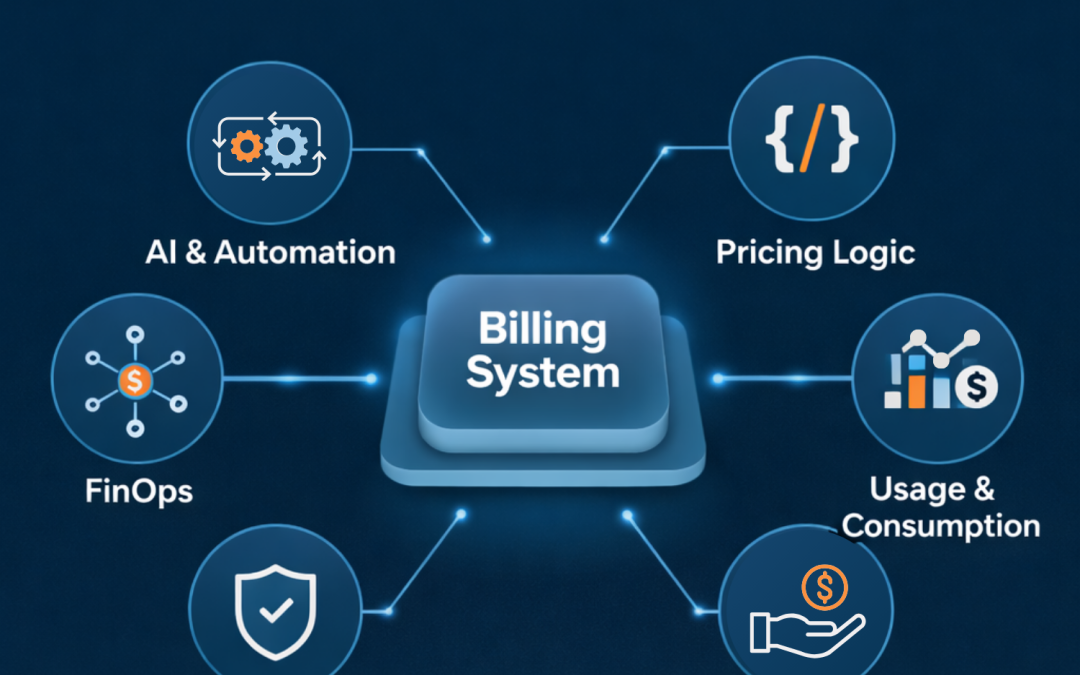
Post Covid, we have seen that billing systems have quietly moved from back-office utilities to core infrastructure for revenue, trust, and scale. As pricing models evolve, AI workloads surge, regulatory pressure increases, and the expectations placed on billing systems are changing fast.
Looking ahead to 2026, we at Synthesis see several clear trends emerging. Here are the six predictions shaping the future of billing systems.
1. AI-Driven Billing Agents Become Mainstream
Academic research is already demonstrating how autonomous FinOps agents can reconcile heterogeneous billing data sources and generate actionable cost-optimization recommendations automatically. These AI-driven systems don’t just report; they act.
By 2026, we expect billing systems to increasingly embed AI agents that:
-
- Continuously scan for anomalies across usage, rating, and invoicing
- Forecast usage and revenue in near real time
- Surface optimization opportunities before revenue leaks occur
The result is a shift from reactive billing operations to real-time revenue intelligence, where issues are detected and addressed before they reach finance or customers.
2. Pricing Becomes Part of Core Engineering (Pricing-as-Infrastructure)
Pricing is no longer a static spreadsheet or a one-time product decision. It’s becoming a living system.
New research from Cornell (García-Fernández et al., 2025) shows how pricing configurations can be automated and validated using constraint-satisfaction models, effectively treating pricing rules as code. This aligns with what many SaaS and platform companies are already experiencing: pricing changes are frequent, complex, and deeply tied to product behavior.
By 2026, leading companies will:
-
- Treat pricing logic as part of core engineering infrastructure
- Version, test, and deploy pricing rules just like application code
- Expect billing systems to support dynamic, machine-readable pricing models
Billing systems that aren’t designed for this level of flexibility can quickly slow innovation, prompting organizations to rely on experienced partners to bridge the gap.
3. Usage-Based & Consumption Pricing Continue to Surge
Market data, gathered from Spherical Insights, consistently shows a long-term shift toward usage-based and consumption-driven pricing, accelerated by cloud services and AI workloads where value scales with consumption.
Customers increasingly expect pricing to feel:
-
- Fair
- Transparent
- Aligned to actual value delivered
By 2026, more vendors will adopt hybrid billing models, combining:
-
- Base subscriptions for predictability
- Usage, credits, or overages for flexibility and fairness
This hybrid approach places new demands on billing systems, from high-volume usage ingestion to real-time rating and clear invoice presentation.
Our business advisory services (Synthesize), guides you in this subscription model change. We help organizations design, evaluate, and operationalize hybrid pricing and billing architectures that scale. Ensuring usage data, pricing logic, and financial reporting stay aligned as consumption grows. (learn more)
4. Revenue-Sharing Models Become More Fraud-Resistant & Fair
As platforms grow, revenue sharing becomes more complex and more sensitive. Whether it’s marketplaces, creator platforms, or partner ecosystems, trust depends on fair and explainable revenue allocation.
Recent research from Cornell (Ghosh et al., 2025) introduces fairness-first revenue division mechanisms that resist manipulation by design, addressing long-standing concerns around gaming and opacity. For example, in music streaming and digital content platforms, automated bots have been used to artificially inflate plays or usage, quietly skewing royalty payouts in favor of bad actors.
By 2026, we expect billing architectures to:
-
- Support more sophisticated revenue-sharing logic
- Emphasize transparency and auditability
- Build trust with creators, partners, and customers alike
Billing won’t just calculate payouts. It will become a system for trust and credibility.
5. Billing and FinOps Converge
Historically, billing teams and cloud cost teams have operated in parallel, often with different tools, metrics, and priorities. Presently, and moving forward, that separation is breaking down.
As usage-based pricing grows, billing accuracy and cloud cost efficiency become inseparable. The rise of FinOps agents makes this convergence practical, not theoretical.
By 2026, we’ll likely see:
-
- Unified workflows across billing, usage, and cloud costs
- Shared visibility into margins, not just revenue
- Integrated platforms that optimize profitability holistically
This convergence helps organizations move from revenue tracking to margin intelligence.
6. Regulatory & Compliance Complexity Drives Billing Innovation
Global scale brings regulatory complexity, and billing sits directly in the line of fire.
Accounting standards (ASC 606 / IFRS 15), tax requirements, and multi-jurisdiction rules already shape billing architecture decisions. As companies expand globally, manual compliance simply doesn’t scale.
By 2026, billing systems will increasingly need:
-
- Automated tax calculation and reporting
- Audit-ready billing trails
- Robust multi-currency and regional compliance support
Compliance won’t be an afterthought it will be designed into billing systems from the start.
Looking Ahead
By 2026, billing systems will no longer be judged solely on whether invoices go out on time. They’ll be evaluated on whether they:
-
- Protect revenue
- Enable pricing innovation
- Support trust and transparency
- Scale globally without adding risk
For organizations preparing for the next wave of growth, billing is no longer just an operational concern; it’s a strategic capability.
The question isn’t whether billing systems will evolve; it’s whether yours is ready for what’s coming.
Please reach out to our team to see if your billing and revenue systems are truly future-ready.