
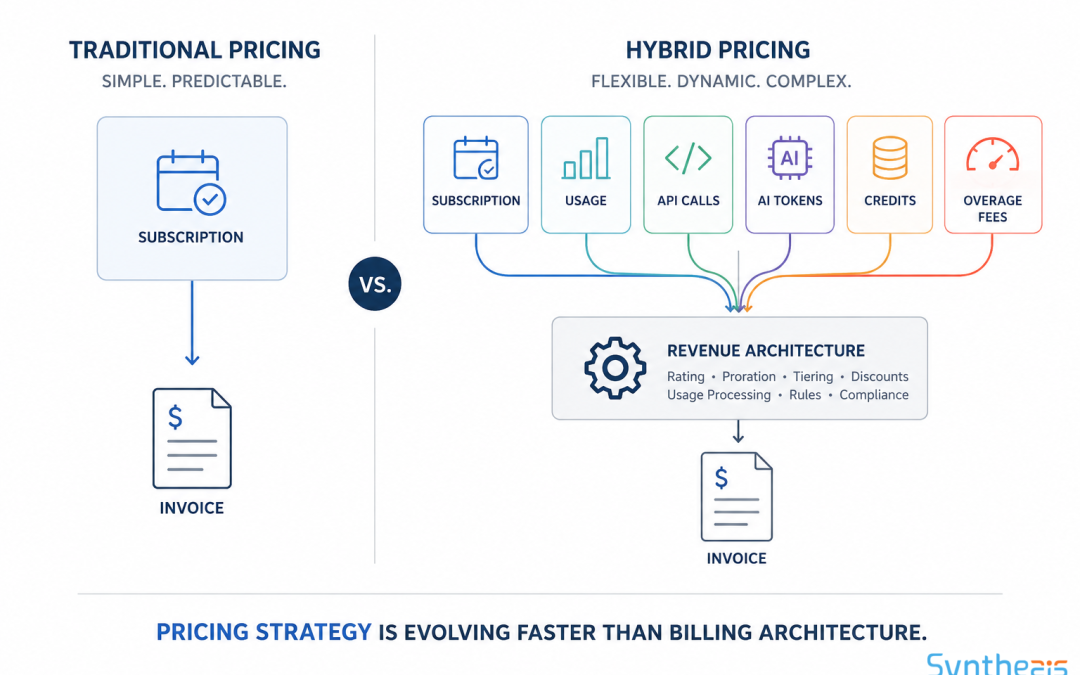
For years, software pricing was refreshingly simple. Customers paid a subscription fee and billing systems were built around one core assumption: price is fixed.
That assumption is quietly eroding.
Across SaaS, AI, cloud infrastructure, and digital services, companies are moving toward hybrid pricing models that layer usage-based charges, consumption tiers, overages, and transactional fees onto traditional subscriptions. Hybrid pricing is becoming the norm.
Unfortunately, many billing environments were never designed for it.
The symptoms usually show up long before anyone in leadership connects the dots. Pricing changes start taking months instead of weeks. Finance teams grow increasingly dependent on spreadsheets to fill gaps. Billing staff spend their days managing exceptions rather than enabling growth.
Related Reading: When Subscription Business Models Stop Scaling: Signs Your Revenue Architecture Needs a Strategic Review
Modern Monetization is Outgrowing the Billing Architectures That Support it
Much of this shift is being driven by AI. Tokens, API calls, model usage, credits, and consumption-based services are forcing companies to rethink pricing models that remained largely unchanged for years.
But AI is only the most visible example.
Cloud platforms charge by consumption. Communications providers bill per message or transaction. Even conventional SaaS vendors are increasingly bundling platform subscriptions with variable usage components.
Traditional subscription pricing works best when product usage is relatively predictable. Today's digital products rarely fit that model. For businesses, the upsides are real: lower barriers to entry, more expansion revenue, and pricing that can flex across different customer segments. The downside is an operational complexity that rarely makes it into the boardroom presentation.
The Complexity That Doesn't Show Up in the Pitch Deck
Take a relatively straightforward example.
A customer pays a monthly platform fee, per-seat charges for active users, usage fees for API calls, and overage charges beyond a certain threshold.
What looks like a single product now requires multiple rating methods, separate usagecollection processes, distinct RevRec treatments, and a more complicated invoice.
Each is manageable on its own. Together, they expose gaps in systems that were designed for something much simpler.
Related Reading: AI Pricing Is Changing. Your Billing Stack Probably Isn't
Three Signs Your Billing System is the Bottleneck
The clearest signal is when pricing changes turn into engineering projects. But there are two others worth watching for, and they tend to show up quietly, long before they become a crisis.
- Every Pricing Change Becomes an Engineering Project
Product teams propose a new monetization structure, leadership approves it, someone builds a revenue model and then the question surfaces: can the billing system do this?
If the answer consistently requires custom development or significant implementation work, the billing infrastructure effectively sets the ceiling on pricing strategy.
- Finance is Managing Complexity, Not Revenue
When systems can't keep up, finance teams compensate through manual workarounds.
Spreadsheets become load-bearing. Reconciliation takes longer. Month-end close stretches out.
This is usually not a people problem; it's a sign that the underlying system was not designed for the business model it's now being asked to support. Over time, those workarounds tend to introduce reporting inconsistencies and revenue leakage that only surface during an audit or a due diligence process.
Related Reading: The Revenue Problem That Survives Every Platform Upgrade
- Customer Invoice Questions Require Manual Investigation
When a customer calls with a question about their invoice, how long does it take to answer?
Invoices that combine subscriptions, usage, credits, and overages require clear audit trails. Organizations that lack visibility end up manually reconstructing charges across multiple systems just to handle routine support questions, creating friction for customers and internal teams alike.
AI is Making This More Urgent
AI is amplifying a challenge that already exists.
Consumption-based monetization is a natural fit for AI services, but the scale is different. Charging by token, inference, or API request can generate millions of usage events per customer every month.
The challenge is not designing the pricing model. The challenge is building the infrastructure to collect, rate, invoice, recognize revenue, and report against that volume reliably.
Related Reading: AI Pricing Is Changing. Your Billing Stack Probably Isn't.
The Question Worth Asking Before the Pricing Conversation
Most leadership teams spend a lot of energy debating whether a hybrid pricing model makes strategic sense. That's a worthwhile conversation. But a more practical question often goes unasked: can our revenue architecture support where our pricing strategy is heading?
Companies that ask that question early tend to move faster. They can test new monetization ideas, launch offerings without rebuilding processes from scratch, and respond to changing customer expectations without a major systems project each time.
Hybrid pricing is not simply a pricing decision.
It is a revenue architecture decision.
The organizations that move fastest over the next few years will not necessarily have the most innovative pricing models. They will be the ones whose systems, processes, and data can support those models without creating operational friction.
Pricing strategy defines how you monetize value.
Revenue architecture determines whether you can execute it.