
Ask five executives to define pricing, billing, and monetization, and you'll likely get five different answers.
That's not surprising.
The terms get used interchangeably by software vendors, consultants, and internal teams alike.
For a long time, that ambiguity didn't cost much as the operational distance between the concepts was small. That's changed.
Today, companies are monetizing AI interactions, API consumption, data access, platform ecosystems, outcome-based services, and increasingly sophisticated combinations of recurring and usage-based revenue.
As complexity increases, so does the importance of understanding where pricing ends, where billing begins, and how both fit into a broader monetization strategy.
Understanding the distinction has gone from a terminology exercise to an operational capability.
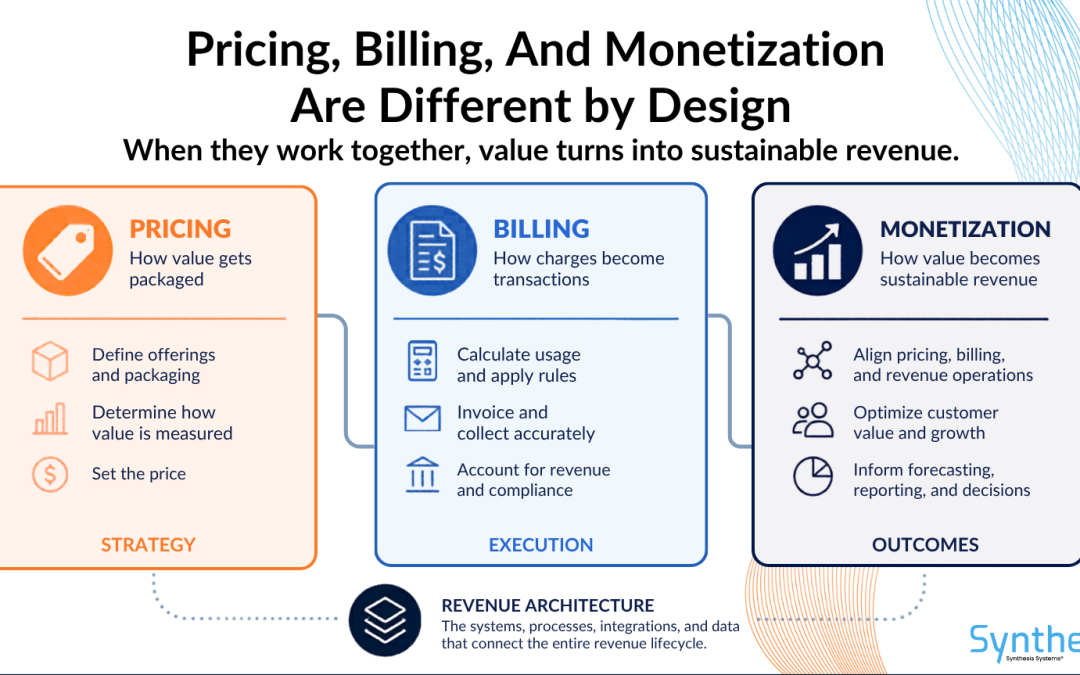
Pricing: How Value Gets Packaged
Pricing answers the question: How do we charge for the value we create?
It's a business strategy function, driven by product, marketing, finance, and executive leadership.
Pricing determines:
- What customers buy
- How offerings are packaged
- How value is measured
- What customers pay
When a leadership team debates whether to move to consumption-based pricing, whether to sell AI features as a separate tier, or whether to introduce a premium package, they're having a pricing conversation.
Pricing defines the business model. It doesn't define how that model gets executed.
Billing: How Charges Become Transactions
Billing answers: How do we calculate, invoice, collect, and account for what customers owe?
If pricing defines what should happen, billing is what makes it happen.
A pricing model that seems clean on a slide deck can get complicated quickly once it hits a real billing environment.
Take a hybrid model with a platform subscription, per-user fees, API consumption charges, and overage thresholds.
From a pricing perspective, that's one product.
From a billing perspective, it may require multiple rating methods, separate usage processing workflows, distinct invoice calculations, and additional reconciliation processes.
This is why pricing innovation so often outpaces billing infrastructure. The strategy gets approved before anyone has fully thought through the operational complexity of supporting it.
We've seen organizations spend months refining a pricing model only to discover that implementing it requires significant changes to billing processes, integrations, reporting structures, or customer support workflows.
The pricing decision was sound but there was a lack of operational readiness.
Monetization: How Value Becomes Revenue
Monetization is the broader discipline that connects pricing strategy to billing execution.
It answers is: How does customer value become sustainable business revenue?
That encompasses pricing, packaging, billing operations, revenue management, customer expansion, and optimization. The full system that turns product usage into business outcomes.
This distinction is becoming more important because companies are no longer monetizing simple subscriptions.
They're monetizing:
- AI interactions
- API consumption
- Data access
- Platform ecosystems
- Usage events
The challenge isn't setting a price. It's building a repeatable system that can measure value, charge appropriately, collect revenue, and support growth as the business evolves.
That entire system is monetization.
Precision Is a Competitive Advantage
Many organizations think they have a pricing problem. In reality, they have an operationalization problem.
As revenue models become more dynamic, the distinction between pricing, billing, and monetization becomes more than a matter of terminology.
It becomes a matter of execution.
Organizations that blur the lines between the three often struggle to launch new offerings, adapt pricing models, forecast revenue accurately, or scale efficiently.
Organizations that understand how these disciplines connect, and build the operational infrastructure to support them, can move faster with far less friction.