
Several publications picked up a story this week about a company that reportedly spent $500 million on Claude usage in a single month after failing to set limits on employee access.
Whether the number is exactly right almost doesn't matter.
What matters is that CFOs are starting to ask questions that many AI projects were never designed to answer.
The AI conversation is starting to follow a familiar pattern.
We saw it during cloud adoption. Infrastructure moved from CAPEX to OPEX. Flexibility increased, but so did the need for cost controls, governance, and visibility into consumption.
The next wave of discussions will focus on what it costs, how it is governed, and whether organizations can monetize it.
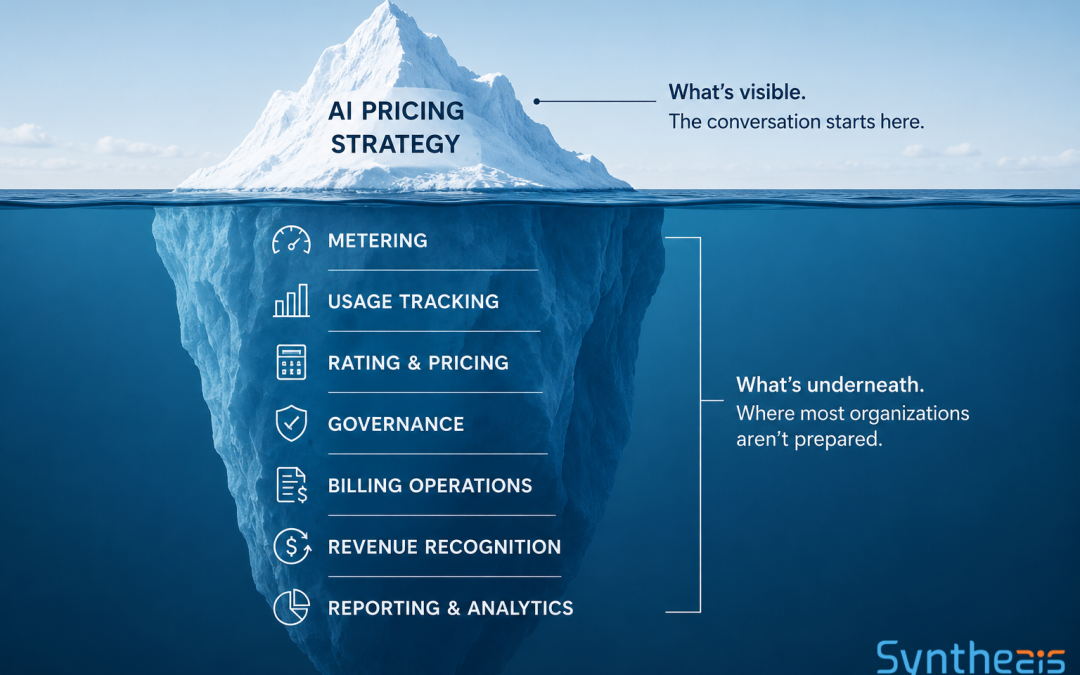
We are already seeing this show up in customer conversations. The discussion is no longer just about AI capabilities or pricing models. It is becoming a discussion about metering, governance, revenue recognition, reporting, and whether existing billing infrastructure can support AI-driven consumption at scale.
GitHub Copilot's Token Billing Backlash Is a Warning for Every Software Company
GitHub's announcement that Copilot is moving from flat-rate subscriptions to usage-based billing didn't land quietly. Developers pushed back hard, and the frustration was understandable. Nobody likes to discover that a tool they budgeted for as a fixed monthly cost can now scale unpredictably with how much they use it.
But GitHub's decision is not really about pricing.
It is about economics. The backlash is understandable, but it misses the bigger story.
Why the Economics of Flat-Fee AI Pricing Do Not Work
Traditional software pricing was built around a simple assumption: usage is roughly predictable. You buy a license, you add users as you grow, costs scale gradually. That model held up for decades because the software itself didn't consume meaningful compute resources every time someone opened it.
AI breaks that assumption entirely. Every prompt, every agent action, every automated workflow execution has a real cost attached to it. That cost varies enormously depending on how the tool is used. A developer occasionally asking Copilot to suggest a function completion is one thing. A team running autonomous coding agents continuously across a large codebase is something else altogether, consuming orders of magnitude more compute in the process.
GitHub's move to usage-based billing isn't a pricing experiment. It's an acknowledgment that the economics of operating AI at scale simply don't fit inside a flat monthly fee.
GitHub Will Not be the Last
What's happening at GitHub is already playing out across the broader software industry, just at different speeds. Microsoft, Salesforce, Anthropic, OpenAI, and countless AI-native platforms are all converging on some version of consumption-based pricing. Whether it’s through pure usage metering, AI credits, hybrid models, or something else entirely, the direction is becoming clear.
The specific mechanics differ, but the direction is consistent: as AI becomes embedded throughout enterprise software, the pricing start to follow the consumption
The More Complex Problem
Most of the conversation around AI monetization focuses on the pricing question itself. Should you charge per token, per outcome, per user, or through credits? These are legitimate strategic questions, but they're not the most difficult ones.
The harder problem is operational. Every new pricing metric creates downstream complexity that most organizations aren't prepared for. A seat-based subscription generates a handful of billing events per month. An AI-powered platform running agentic workflows can generate millions. Capturing, rating, invoicing, reconciling, and reporting on that volume of consumption data is a fundamentally different challenge, and most billing infrastructure was not designed for it.
The symptoms usually appear before the root cause is obvious. Manual workarounds multiplying, reconciliation taking longer, product launches delayed while teams figure out how to meter something the billing system was never built to handle. Revenue leakage that's hard to quantify but easy to feel.
What GitHub's Announcement Signals
The real takeaway isn't that token-based pricing is becoming more common; that much was already clear. It's that one of the most widely used AI products in the world has now publicly demonstrated what the economics of operating AI at scale require.
For any company building or buying AI-enabled software, that's a signal worth taking seriously. The forces that pushed GitHub to rethink its pricing model are not unique to GitHub. Pricing strategy and billing architecture have to be treated as connected problems, one determines what you charge, the other determines whether you can collect it, report on it, and scale it.
The organizations that navigate this transition well won't be the ones that figured out the right pricing model first. AI may be changing how software is built and consumed. The bigger question is whether organizations are ready to measure it, govern it, bill it, and monetize it.