
For more than a decade, the subscription and recurring revenue model has fueled business growth across industries: SaaS, streaming, telecom, consumer goods, and beyond. But the competitive advantage of simply having a subscription model is fading. Today, the difference between leaders and laggards is how well they leverage Artificial Intelligence (AI) to optimize, personalize, and protect revenue streams.
The companies that embrace AI in subscription monetization are set to dominate. Those who don't risk being left behind.
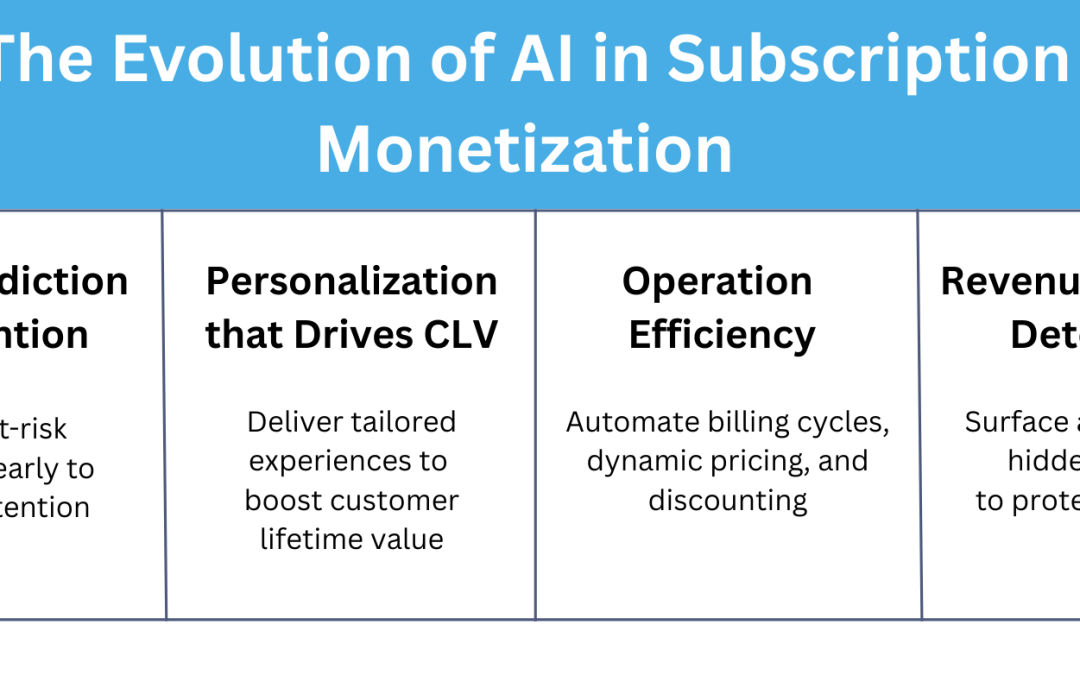
Churn Prediction & Prevention: The First Line of Defense
In recurring revenue businesses, churn is the enemy. Every lost customer represents not just immediate revenue loss but also the sunk costs of acquisition.
AI changes the game by making churn prevention proactive rather than reactive.
By consuming and analyzing vast datasets, including customer behavior, product usage, engagement frequency, payment history, and sentiment from support cases, AI algorithms can detect subtle patterns that indicate when a customer is likely to cancel.
In some cases, AI can flag risk even before a customer signs up, enabling more targeted acquisition strategies.
Example: A SaaS provider used AI-driven churn modeling to trigger personalized retention offers for at-risk customers, reducing churn by 18% in one quarter.
Personalization That Drives CLV
Personalization isn't a nice-to-have anymore; it's a competitive necessity.
As the subscription market matures, generic, one-size-fits-all experiences fail to engage and retain. AI allows companies to deliver experiences tailored to individual customers at scale.
From content curation to UI adaptation, from pricing adjustments to process streamlining, AI can analyze historical behavior and predict what will delight the customer next. This results in higher engagement, improved satisfaction, and increased Customer Lifetime Value (CLV).
Example: A digital subscription service used AI to recommend usage-based feature bundles, increasing upsell revenue by 12% while boosting satisfaction scores.
Operational Efficiency: Automating the Complex
Billing and revenue operations in subscription businesses are complex by nature. Multiple pricing tiers, usage-based billing, proration, and mid-cycle upgrades all create room for manual errors, process delays, and customer frustration.
AI tools and Robotic Process Automation (RPA) can streamline and automate critical revenue operations:
- Automated billing cycles that adjust in real time.
- Dynamic pricing that adapts to market conditions.
- Instant discount application based on customer behavior.
- Automated credit validation to prevent payment failures.
These improvements reduce errors, speed up financial processes, and ultimately contribute to a better customer experience.
Revenue Leakage Detection: Plugging the Hidden Gaps
In high-volume, low-complexity businesses or low-volume, high-complexity ones, revenue leakage is inevitable, but it doesn't have to be uncontrollable.
Small transactional errors often go unnoticed but accumulate over time. Worse, they repeat and compound. At the scale of a subscription business, these leaks can result in significant revenue loss without obvious signs in day-to-day reporting.
AI tools, such as xfactrs, are purpose-built to monitor for anomalies and surface high-impact leakage areas continuously. By identifying and resolving these issues early, businesses can reclaim revenue that would otherwise disappear into the shadows.
Example: a law firm used AI to review their invoicing process for anomalies and identified a 14% revenue loss in their billing process.
Why AI Is Now a Necessity, Not a Luxury
The subscription economy has moved beyond the point where AI is an experimental tool. It is now an operational necessity for:
- Understanding customers at unprecedented depth.
- Operating with greater accuracy and speed.
- Building loyalty that withstands competitive pressure.
- Protecting revenue from both churn and hidden loss.
Companies that invest in AI now are not just improving operations, they are reshaping their future competitive position.